

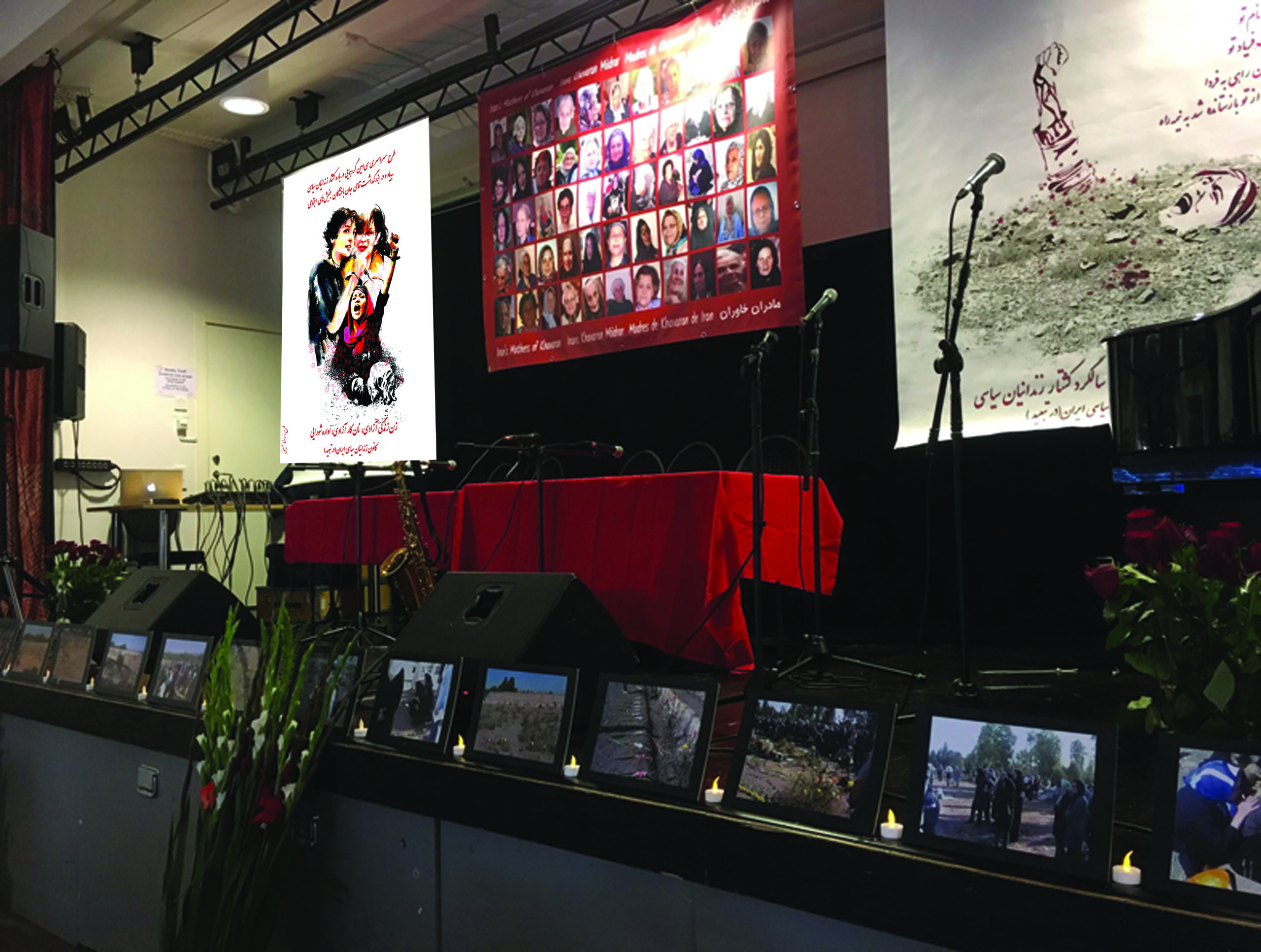
The 33rd Gathering Regarding the Massacre of Political Prisoners
We are holding the 33rd gathering on the killing of political prisoners this year, while the criminal regime of the Islamic Republic has sharply increased the wave of issuing and executing death sentences for political prisoners in Iranian prisons, while Iranian cities are under attack by American imperialism. The images of black bags carrying the cold, bloodied bodies of thousands of young fighters in January 1404 have not yet been erased from the collective memory of the masses of the people, when the criminals ruling Iran, in addition to executing 24 protesters of the mass movement of January in prison, also publicly hanged two young protesters in Isfahan. The Islamic Republic, which is deeply afraid of the return of the masses of the people to the streets, has once again returned to the public executions of the 1980s, when it hanged a number of political prisoners in public.
.
In the early years of the 1980s, the Islamic Republic of Iran committed the greatest crime in the contemporary history of Iran by killing thousands of its opponents in Iranian prisons. A few years later, in the summer of 1988, Ruhollah Khomein, the late leader of the regime, ordered the killing of political prisoners who had survived the massacres of the early years of 1980s. The prisoners were killed in secret, defenseless, and their bodies were buried in mass and unmarked graves.
.
The Islamic Republic did not limit its atrocities to the 1980s. Generation after generation, it met every voice of dissent and protest with gunfire, imprisonment, torture, and execution. It slaughtered freedom-seekers on the streets of Iran—during social movements, the uprisings of January 2018 and November 2019, and the “Woman, Life, Freedom” revolutionary movement of late 2022 and January 2026—with violence and brutality beyond human comprehension; it incarcerated them and, while they were utterly defenseless and alone, consigned them to the firing squad to instill fear in the hearts of the people. This regime, with all this blood on its hands, is unchangeable and will kill again if it remains. Even now, its prisons are full of political prisoners sentenced to death, whose lives are in danger at any moment.
.
At its thirty-third gathering regarding the massacre of political prisoners—to be held at 6:00 PM on Saturday, September 19, 2026, at the Husby Träff hall in Stockholm—the Association of Iranian Political Prisoners (in Exile) honors the memory of thousands of women and men who lost their lives during the 1980s and the subsequent decades in the struggle for freedom and liberation from the oppression, tyranny, and despotism of the Islamic Republic. On this day, standing alongside the families and the justice-seeking, long-suffering masses of the Iranian people, we will loudly proclaim that the pursuit and attainment of justice are impossible without the revolutionary overthrow of the Islamic Republic and the rise to power of the masses of labor and toil.
.
The event’s speakers—Shahla Talebi, Nasser Mohajer, and Fariba Sabet—will address the following topics respectively: “From the Depths of Pain and Grief: Intergenerational Bonds and the Justice-Seeking Movement,” “The ‘Tuesdays of No to Execution’ Campaign in Light of the 1988 Massacre,” and “An Unsilenced Truth: From the 1980s to the ‘Woman, Life, Freedom’ Movement.” They will examine the concept of “unfinished generations” and the cause of justice-seeking as a social movement—a banner first raised by the Mothers of Khavaran and subsequently carried forward by the mothers of the November 2019 (Aban) protests, the “Woman, Life, Freedom” movement of 2022, and the bereaved mothers of the January 2026 (Dey) events.
The event’s guest artist, innovative singer Aida Jabbari, will perform a selection of songs accompanied by the piano.
.
Association of Iranian Political Prisoners (in Exile)
August 7, 2026, corresponding to Mordad 19, 1405